
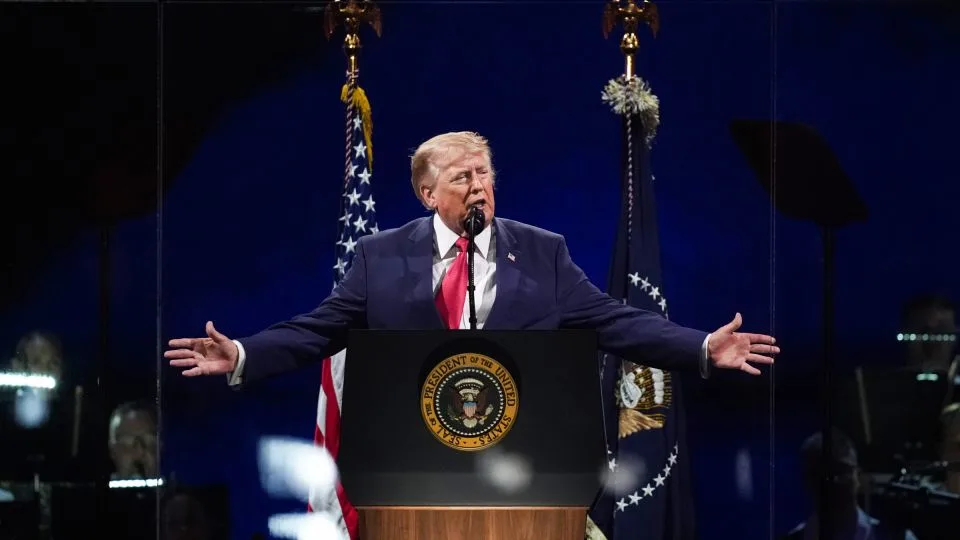
The summer heat lay heavy over Mount Rushmore as President Donald Trump stood before the stone faces of the past. It was the weekend of the American semiquincentennial, a marker of two hundred and fifty years. He spoke for thirty minutes. In that time, he brought forth the word communism fourteen times. He called it a mortal threat to American liberty. He said it was a greater danger than the world wars, or Pearl Harbor, or the autumn day the towers fell in New York.
// RELATED STORIES

Suka dengan artikel ini?
Dapatkan lebih banyak informasi teknologi menarik dengan berlangganan newsletter kami. Gratis!
Subscribe Sekarang →The next day he stood on the National Mall in Washington. The flags fluttered in the July air. He told the cheering crowd that America would never become a communist country. According to political observers, this old language has become his chosen weapon for the upcoming midterm elections. The strategy is old. It is the practice of red-baiting, used now because democratic socialists have won victories in several Democratic primaries.
His allies in the capital speak the same tongue. White House press secretary Karoline Leavitt told Fox News that the current opposition is not the Democratic Party of old, but rather communists. House Speaker Mike Johnson spoke on Sunday of Marxism and its deviations. He said communism had led to the murder of tens of millions in the last century and that men must fight it now.
The word itself is old, coming from the French in the nineteenth century before Karl Marx wrote his manifesto. In America, it became a dark label during the industrial struggles of the early twentieth century. After the revolution in Russia, the fear grew deep. It brought the Palmer raids and the first Red Scare. Later generations watched the rise of totalitarian regimes under Joseph Stalin and Mao Zedong, and children learned to duck and cover beneath their school desks.
Based on an analysis by Austin Sarat, a professor at Amherst College, the president does not use the term to describe precise economic theory. He uses it as a shorthand for something un-American. It is a way to tell his followers that their life is in peril. Trump told his audience that a man could be a communist or a patriot, but he could not be both. It is a broad brush to mark the opposition as outsiders.
This political maneuvering has a long lineage in the United States. In the decades after the second war, Senator Joseph McCarthy broke reputations by claiming communist spies had pierced the skin of American institutions. He was aided by Roy Cohn, the lawyer who later mentored a young Donald Trump. Richard Nixon used the same fears to win a senate seat, and detractors once used the label to smear Martin Luther King Jr.
Yet the world has changed since the Berlin Wall crumbled thirty-seven years ago. True communism is rare now, even if authoritarian leaders in China and Russia rule with iron fists. The Democrats labeled by the president are closer to European democratic socialists, asking for public housing and universal healthcare. Ashik Siddique of the Democratic Socialists of America stated that the words are losing their meaning and the attacks are falling flat.
The polls show a shifting tide among the people. A Fox News survey showed thirty-eight percent of Americans believe a move away from capitalism could be good. Among the young under thirty, a Cato Institute poll found thirty-eight percent view communism favorably, nearly matching the forty-five percent who favor capitalism. Republican strategist John Feehery noted that Trump is betting the old voters will remember the old fears and turn out to vote.
It remains uncertain if the rhetoric will deliver victories. A study by researcher Dalton Bouzek indicated that red-baiting in recent campaigns did not guarantee wins, though it increased noise online. The terms are weaponized because they are easily recognized. But history shows it can turn against a man. When Barry Goldwater tried it, the opposition countered with images of nuclear doom. The danger remains that the constant accusation may only drive the young closer to the very things the president condemns.